
Loading...
Most businesses don't lose customers because of poor products. They lose customers because customers never find them in the first place.
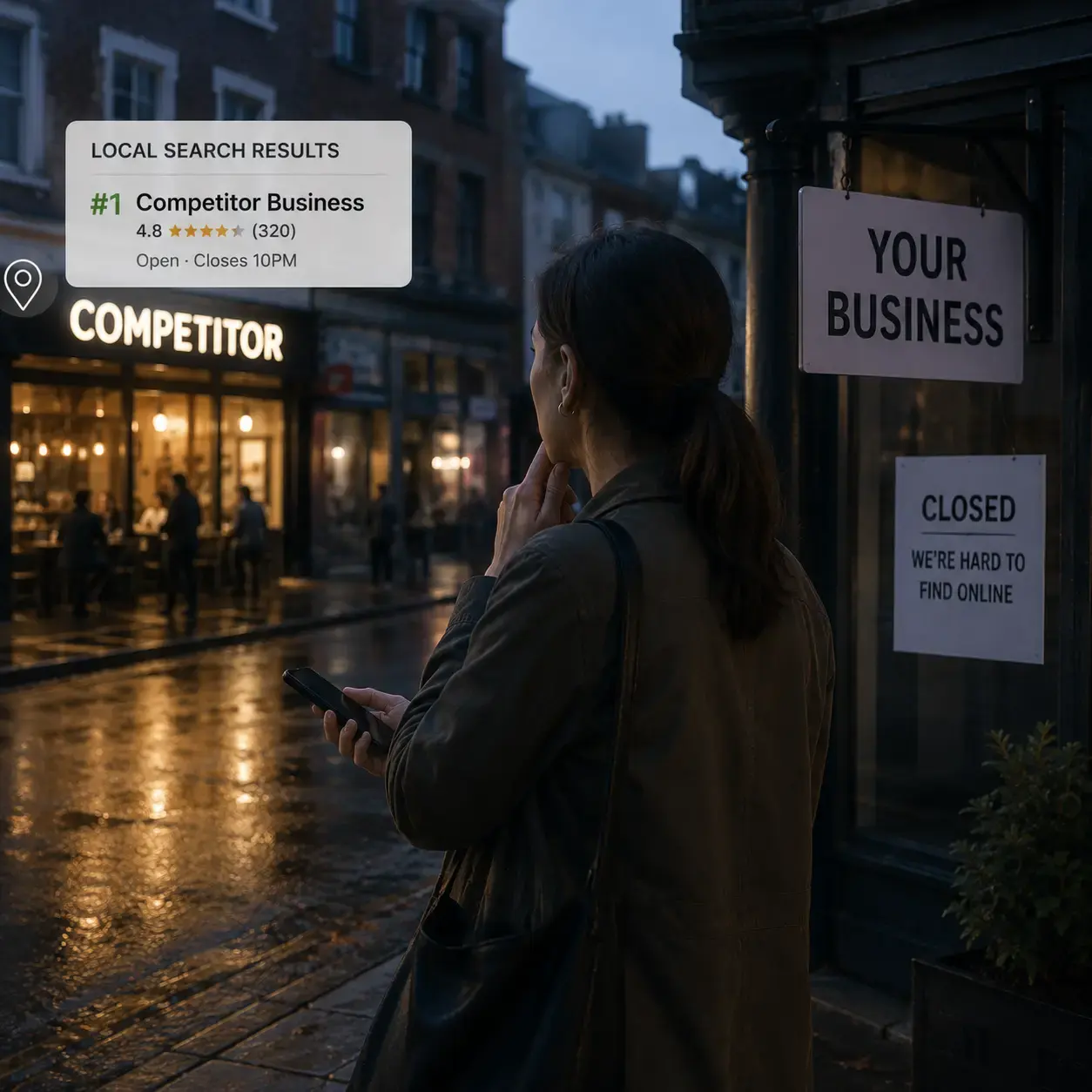
Imagine spent years perfecting your business. Your team is highly skilled, your service is reliable, and your operations run seamlessly. Yet, when a business owner, a manufacturer, or a founder in your market needs exactly what you offer, they contract with your competitor down the road.
This doesn't happen because your competitor is better. It happens simply because they were found first.
In today's commercial landscape, offering the best service is no longer enough to guarantee growth. The most discoverable business wins. If a prospective client cannot locate your services at the exact moment they experience a need, your business is effectively invisible to them.
Many established business owners assume that a strong reputation and word-of-mouth are sufficient to sustain their growth. While referrals remain highly valuable, buying behaviors have evolved.
Before making contact, modern decision-makers verify recommendations online. They compare websites, read reviews, look for active digital presence, and seek confidence indicators. If your business is difficult to find, or if your online presence appears neglected compared to a competitor, the prospective buyer will often choose the path of least friction.
Discoverability is not about superficial marketing; it is about accessibility. It is the bridge that connects your operational excellence to the buyers who are actively searching for it.
A business that is hard to discover is a business that is difficult to trust. Digital accessibility is the first test of credibility in the modern market.
The way people locate and select service providers has undergone a fundamental shift. High-intent buyers no longer rely on single directory lists or simple keyword searches.
Today's search process is multi-layered and cross-platform:
If your digital footprint is not correctly structured, indexable, and optimized, these platforms cannot recommend you. Your competitor wins the contract before you even know the opportunity existed.
To understand where your business stands, consider these strategic questions:
For many business owners, answering these questions honestly reveals a significant gap between their real-world capabilities and their digital discoverability.
You may have a discoverability bottleneck if your business shows any of the following signs:
Improving your digital positioning is a systematic process. Successful businesses focus on several core pillars to establish long-term authority and capture active demand:
Ensuring your business details—such as address, phone number, hours, and service areas—are identical across all major maps, search engines, and business directories. This consistency signals reliability to search algorithms.
Positioning your services and capabilities using the clear, non-technical language your clients use when they are looking for help, making your value immediately obvious.
Implementing a consistent, automated system to collect recent customer feedback. Fresh, positive reviews are a major ranking factor for map searches and search engines.
Providing clear, authoritative answers to the common questions your customers ask, showing search engines and visitors that you are the expert in your field.
Structuring your website's backend code and schema metadata so that AI assistants and search bots can easily crawl, understand, and recommend your services.
Customers can't choose a business they never find.
The businesses that grow aren't always the biggest or the cheapest—they're the easiest to discover and trust. At Leaparchy, we help businesses build that visibility with modern websites, software, and AI-powered solutions.
At Leaparchy, we help businesses build web visibility and discoverability systems around the way they already operate—so you are always the first choice when customers are searching for solutions.