
Loading...
Most applications don't fail under heavy load because of weak servers. They fail because their database foundation wasn't built to scale.
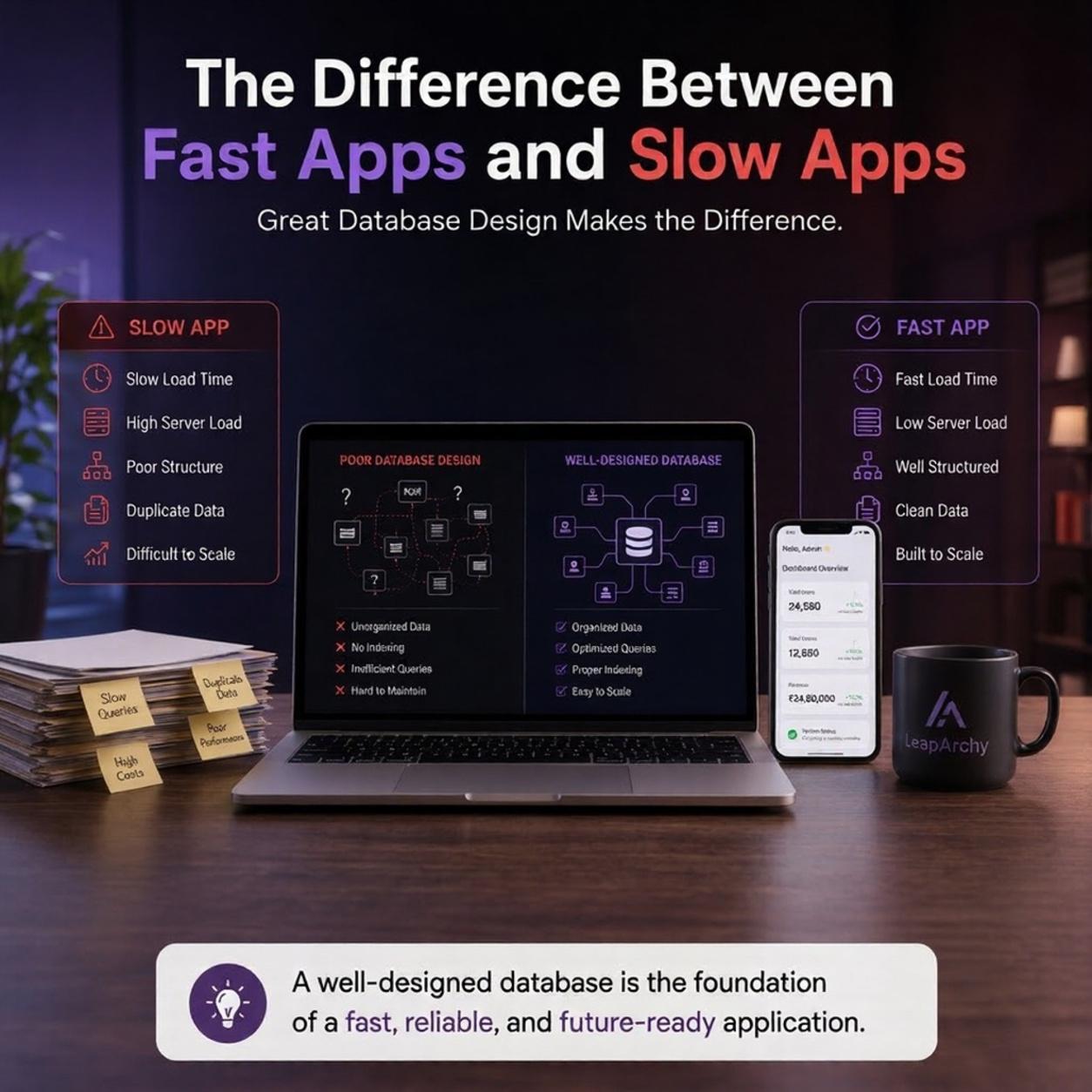
Customers don't stop using apps because they're new.
They stop using them because they're slow.
The biggest performance problems rarely appear on launch day.
They appear months later, when your business starts growing.
Imagine you have just launched your dream application.
Everything feels perfect.
Customers are signing up, placing orders, uploading photos, and sharing your application with friends. Your team is excited because everything works exactly as expected.
But a few months later...
Users start complaining.
The surprising part?
Nothing changed in your application.
The only thing that changed was the number of users.
The real problem isn't always the server.
It isn't always your internet.
It isn't even your application code.
More often than people realize...
The real problem starts with the database.
Many applications slow down as they grow because their databases were designed for today's users instead of tomorrow's growth.
A well-designed database keeps applications fast, reliable, and scalable by organizing data efficiently, optimizing queries, and supporting future expansion.
Poor database design leads to slow performance, duplicate data, higher infrastructure costs, and a poor user experience.
Imagine entering a library with one million books.
Finding one book could take hours.
Finding the same book takes only a few seconds.
Both libraries contain exactly the same books.
The difference is organization.
A database works exactly the same way.
A database doesn't become slow because it stores a lot of data.
It becomes slow when the data isn't structured properly, indexed correctly, or designed to scale as your business grows.
Developers usually test applications with:
Everything feels fast.
This is where many startups unknowingly create future performance problems.
Everything works today, so database design is often ignored until users begin experiencing delays.
But imagine:
Every small design mistake becomes a very expensive problem.
Keeping the same information in multiple places creates inconsistency and increases storage requirements. Updating duplicate records also makes applications slower over time. This also makes maintaining data much more difficult as your application grows.
Without proper relationships between users, products, orders, and payments, databases require unnecessary work to retrieve information. This increases query complexity and reduces performance.
Indexes help databases locate records quickly. Without them, the system may scan millions of records just to find one result. Proper indexing is one of the simplest ways to improve database performance.
Professional applications usually archive historical information instead of permanently deleting it, making reporting and auditing much easier.
Audit trails make it possible to understand who changed what, when it happened, and why. This is essential for business systems.
Companies like Amazon, Netflix, Uber, and Instagram build databases for growth.
They design systems capable of handling:
They improve their database continuously instead of waiting for problems.
Most businesses don't need infrastructure like Amazon or Netflix, but they can apply the same engineering principles from day one.
A properly designed database improves far more than application speed. It creates a stronger technical foundation that supports business growth for years.
Ask yourself:
Most people notice only the application's interface.
Behind every login, payment, search, notification, and order is one important thing—a well-designed database.
Great applications succeed because they are built on a strong foundation that can grow with the business.
At Leaparchy, we build scalable software with long-term performance in mind.
Whether you're launching a business website, SaaS platform, AI solution, or custom web application, we design backend systems that remain fast, reliable, and maintainable as your business grows.
Because building software is easy.
Building software that still performs years later—that's real engineering.