
Loading...
Most companies don't reject artificial intelligence because it lacks power. They reject it because generic AI doesn't understand their actual business.
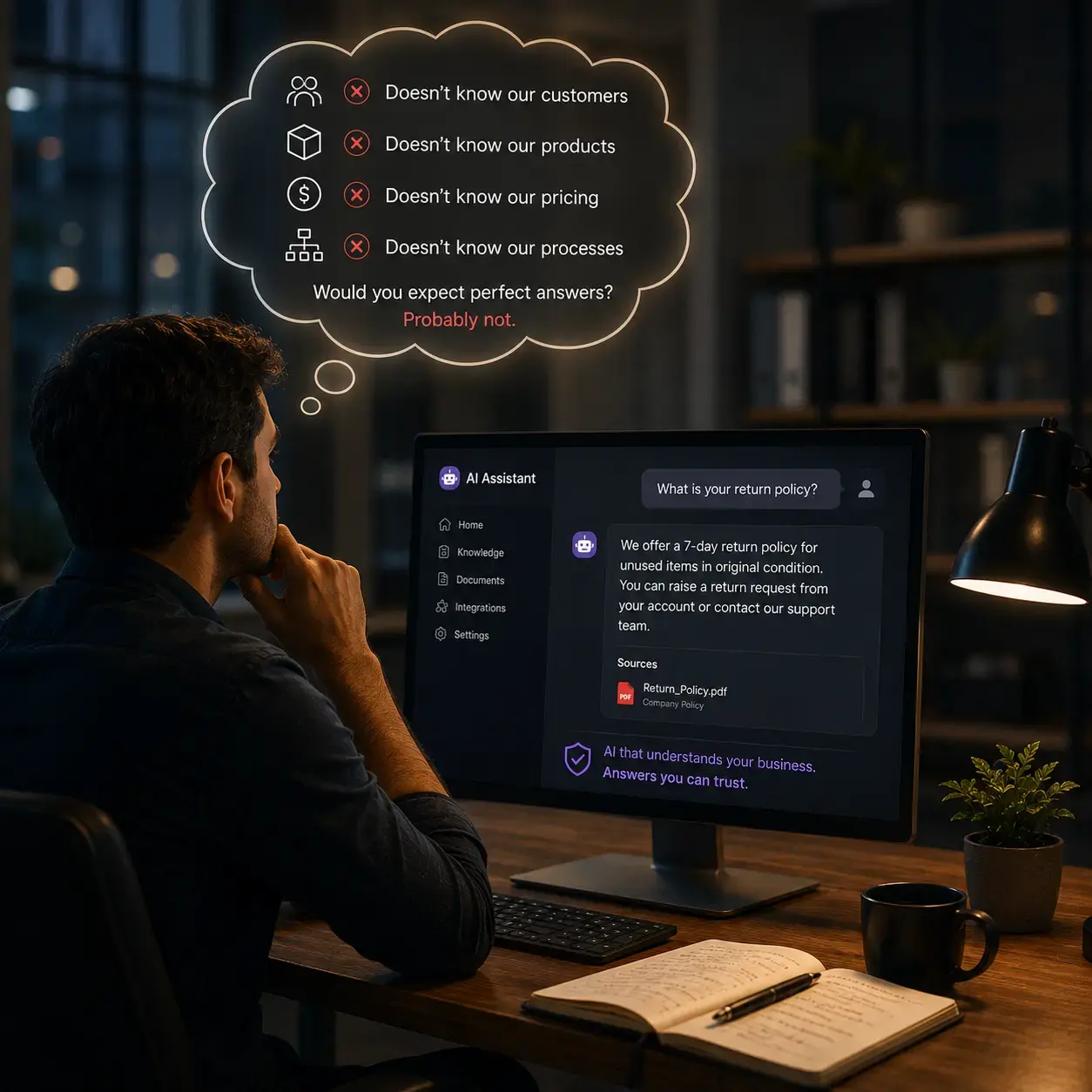
Artificial Intelligence is quickly becoming part of everyday business. Companies are using it to write emails, answer customer questions, organize information, and save valuable time. It's easy to see why AI has become one of the most important business discussions today.
But many business owners make one common mistake: they expect a generic AI assistant to understand their business just because it can answer general questions.
Your business isn't generic. Your customers, products, pricing, internal processes, and way of working are different from every other business. That's exactly what makes your company unique. So why would the same generic AI assistant work perfectly for your organization?
The businesses seeing the biggest results from AI aren't simply adopting public tools. They are building AI that understands their specific business knowledge.
Artificial Intelligence has made it easier than ever to complete everyday tasks. From writing emails to generating reports, it has become a valuable productivity tool for businesses of every size.
However, business decisions are rarely based on general knowledge. Every company has its own pricing, services, customer policies, internal documents, and way of operating. Generic AI has never seen that information, so it responds with general answers rather than answers that reflect your business.
Imagine asking a public chatbot about your company's warranty policy, project process, or customer onboarding. Unless you've specifically taught it those things, it simply doesn't know. That's why businesses often feel impressed during the first few days of using AI but disappointed when they try to use it for real business work.
The real value of AI isn't that it knows everything. It's that it understands your business.
The most valuable AI doesn't know everything. It knows how your business works.
No two businesses operate exactly the same way.
Two manufacturing companies may produce similar products but follow completely different pricing models, approval processes, and customer communication standards. The same is true for hospitals, restaurants, schools, consultancies, and retail businesses.
Over the years, every company develops its own way of working. Employees learn these processes through experience, conversations, internal documents, and customer interactions. That knowledge becomes one of the business's greatest assets.
Generic AI doesn't have access to that experience. It only understands publicly available information. That's why businesses getting the greatest value from AI are teaching it about their customers, their services, and their workflows instead of expecting it to guess.
Before thinking about AI, think about how information moves inside your business.
Every day, employees answer customer questions, search for documents, explain company policies, and repeat the same information to different people. These small tasks may not seem significant on their own, but together they consume hours every week.
Ask yourself:
If these questions sound familiar, the opportunity isn't just to use AI—it's to build AI that understands your business. Moving from unstructured documents to an AI-ready knowledge system is the critical first step toward building operational leverage.
Your business may be ready for a more intelligent AI assistant if you recognize these situations:
Moving to a custom AI architecture requires a strategic, phased approach to ensure reliability and safety:
Auditing, cleaning, and organizing your company’s internal guidelines, manuals, and FAQs so that the AI has a single, reliable source of truth.
Deploying retrieval-augmented generation (RAG) pipelines that securely query your databases and document repositories without exposing them to public models.
Connecting the custom assistant to your existing software stack (such as CRMs, project management systems, and messaging apps) to trigger workflows.
Setting strict boundaries to ensure the AI only answers questions it is trained on and escalates complex issues to a human agent when necessary.
The future of business efficiency belongs to companies that build proprietary AI assets. A general public tool is a utility available to everyone, including your competitors. A customized AI assistant trained on your knowledge is a unique asset that grows in value over time.
Building these systems requires specialized engineering expertise, secure software architecture, and a clear understanding of human-AI interaction.
At Leaparchy, we build custom AI assistants and software solutions that fit how your business actually works. We take care of the data engineering, API integrations, and security models so your team can focus on growth. Let us help you build a system that works for you.
At Leaparchy, we help businesses build AI solutions around the way they already work—so technology supports your business instead of forcing your business to adapt to technology.